
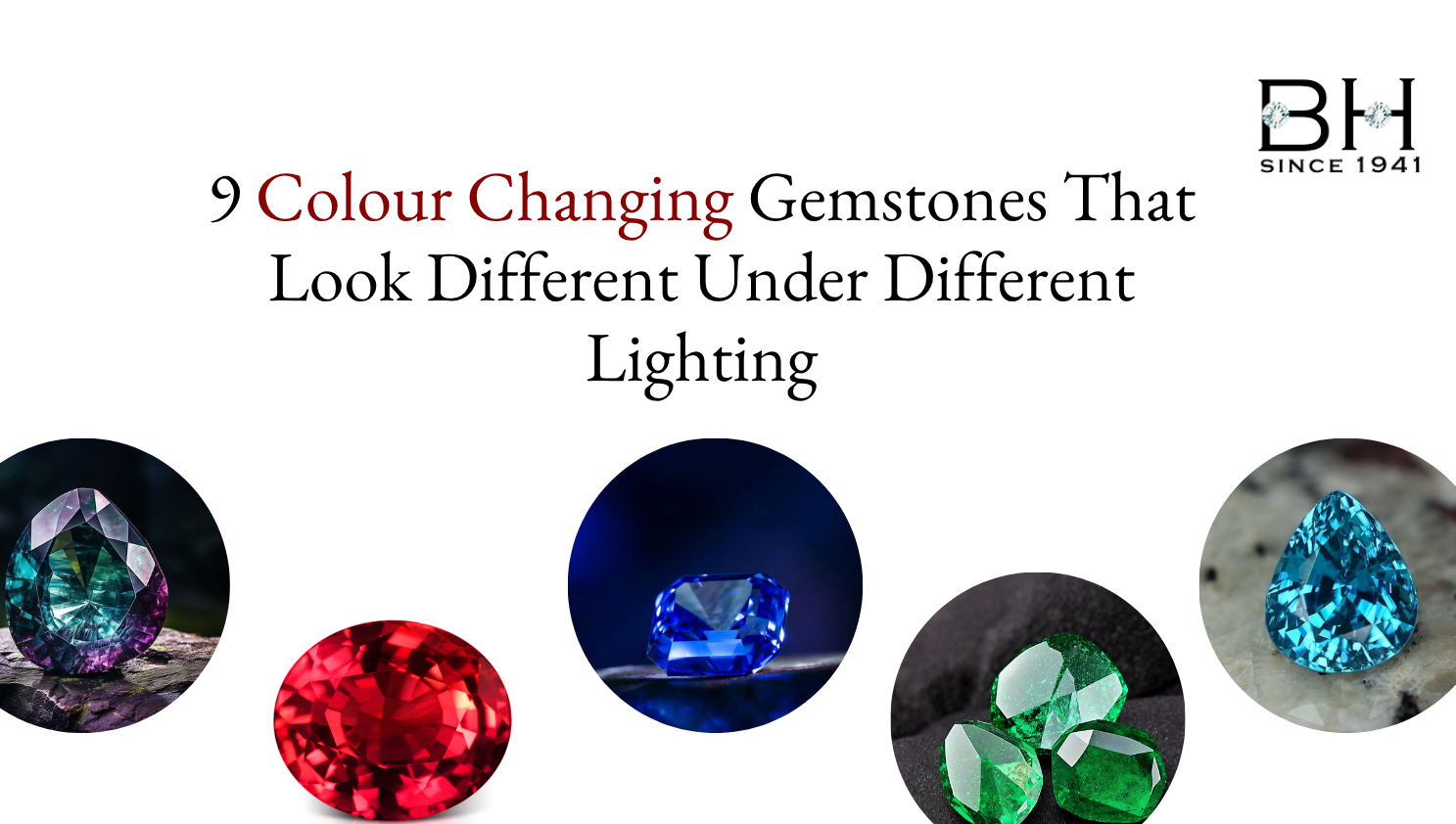
Some gemstones have a fascinating ability to display different colours under different lighting conditions. A stone that looks green in daylight may appear reddish or purplish under warm indoor lighting, creating a distinctive visual effect that makes it stand out from conventional gemstones.
Known as colour change, this phenomenon occurs when a gemstone interacts differently with the wavelengths of light available from different sources. Alexandrite is one of the best-known examples, but certain sapphires, garnets, spinels and other gemstones can also display this unusual characteristic.
For jewellery enthusiasts and gemstone collectors, Colour Changing Gemstones offer a unique combination of natural beauty, optical properties and individuality. However, not every gemstone that appears different in different settings exhibits a genuine colour change.
In this guide, we explore nine gemstones and mineral varieties associated with colour-changing or related light-responsive effects, explain their distinctive characteristics, and share tips for choosing the right gemstone.
What Are Colour Changing Gemstones?
Colour Changing Gemstones are stones that display a noticeable shift in their body colour when viewed under different light sources, such as daylight and incandescent-style lighting.
This effect occurs because certain gemstones absorb different wavelengths of visible light. When the balance of wavelengths changes, the colour perceived by the eye can change as well.
Three optical effects are worth distinguishing:
- Colour change: A gemstone’s apparent body colour shifts when the light source changes.
- Pleochroism: A gemstone displays different colours when viewed from different directions.
- Fluorescence: A gemstone emits visible light when exposed to a suitable energy source, often ultraviolet light.
These effects are different, although more than one may occur in the same mineral.
1. Alexandrite: The Classic Colour-Changing Gemstone
Alexandrite is one of the most famous colour-changing gemstones. This rare variety of chrysoberyl can appear green or bluish-green in daylight and red, purplish-red or raspberry-red under incandescent lighting.
Its distinctive behaviour is associated with chromium in the gemstone’s crystal structure, which influences how it absorbs visible light.
The strength of the colour change varies between specimens. Stones that display a pronounced shift, attractive colours and good transparency can be particularly desirable to collectors.
Best suited for: Statement rings, pendants and distinctive gemstone jewellery.
What to check: Look at the stone under different light sources and assess the strength of its colour change, clarity, cut and authenticity.
2. Colour-Change Sapphire: A Surprising Variety of Corundum
Sapphire is widely known for its blue varieties, but certain sapphires exhibit a noticeable colour change. Depending on the individual stone, the appearance may shift between bluish or violet tones in daylight and purple or reddish-purple hues under incandescent lighting.
These colour differences are influenced by the sapphire’s trace elements and the spectral composition of the light source.
Unlike conventional blue sapphires, which generally maintain a relatively consistent body colour, colour-change sapphires are valued partly for their changing appearance.
Best suited for: Rings, pendants and contemporary jewellery designs.
What to check: Confirm the stone’s identity and examine its colour under both daylight and warm indoor lighting.
3. Colour-Change Garnet: A Rare and Intriguing Choice
Garnet occurs in many colours, including red, orange, green and purple. Some rare garnets, particularly those with particular combinations of pyrope and spessartine, display a genuine colour-changing effect.
Depending on the specimen, the stone may look greenish or bluish-green in daylight before appearing reddish-purple, rose or purple under incandescent lighting.
The exact colour combination varies according to the gemstone’s composition and the lighting conditions.
Best suited for: Collector jewellery, pendants and distinctive rings.
What to check: Evaluate the colour change itself rather than judging the gemstone only by its appearance in a photograph.
4. Colour-Change Spinel: Unusual Colours in One Gemstone
Spinel is available in several colours, including red, pink, purple, blue and grey. Certain rare specimens also exhibit a noticeable colour change under different light sources.
Depending on the stone, its appearance may shift between blue or violet shades and purple, pinkish or reddish tones.
Colour-change spinel is less commonly encountered than many conventional spinel varieties, making accurate gemstone identification particularly important.
Best suited for: Custom jewellery, collector pieces and statement rings.
What to check: Ask for reliable identification and inspect the gemstone under different lighting conditions before purchasing.
5. Colour-Change Diaspore: Green, Champagne and Pinkish Tones
Diaspore is known for its subtle yet fascinating colour variations. Some specimens appear greenish or yellowish-green in daylight and shift towards champagne, pinkish-brown or reddish-brown tones under warmer illumination.
The trade name Zultanite is associated with the colour-changing diaspore from Turkey. However, it is important to understand that Zultanite is a trade name rather than a separate mineral species.
Not every diaspore specimen displays the same degree of colour change. Some exhibit a more noticeable transformation than others.
Best suited for: Pendants, earrings and occasional-wear jewellery.
What to check: Because diaspore has cleavage and requires careful handling, consider a protective setting and ask about appropriate cleaning methods.
6. Colour-Change Fluorite: An Uncommon Optical Effect
Fluorite is admired for its broad colour range, including purple, green, blue and yellow. Certain specimens may show colour variations under different illumination conditions, although pronounced, repeatable colour change is not a universal characteristic of fluorite.
Some fluorite also exhibits fluorescence under ultraviolet light. This is a separate effect and should not be confused with colour change under ordinary daylight and indoor lighting.
Fluorite is relatively soft and has prominent cleavage, making it more vulnerable to scratches and breakage than many traditional jewellery gemstones.
Best suited for: Mineral collections, decorative pieces and occasional-wear jewellery.
What to check: Confirm the specific optical effect being described and consider the stone’s durability before selecting it for jewellery.
7. Colour-Change Tourmaline: A Rare Variation
Tourmaline is found in a remarkable range of colours, including green, pink, red and blue. Certain uncommon specimens may display a noticeable colour change under different light sources.
However, tourmaline is also known for pleochroism, in which its colour appears different when viewed from different directions. This is not the same as a true colour change caused by switching the light source.
When evaluating a colour-changing tourmaline, compare the stone under different lighting conditions while keeping its viewing angle as consistent as possible.
Best suited for: Bespoke jewellery and unusual gemstone collections.
What to check: Ask for evidence of the colour-changing effect and avoid assuming that every multicoloured or pleochroic tourmaline is colour-changing.
8. Colour-Change Zircon: Brilliance and Colour Variation
Natural zircon occurs in several colours, including blue, yellow, brown, red and colourless varieties. Certain rare specimens have been described as showing colour-changing behaviour, although this is not a defining feature of zircon generally.
Zircon is also known for its brilliance and dispersion, which can create colourful flashes as the stone reflects and refracts light. These flashes should not be mistaken for a genuine shift in body colour.
When assessing a claimed colour-change zircon, focus on whether its overall colour changes between light sources rather than simply displaying rainbow-like reflections.
Best suited for: Pendants, earrings and carefully designed rings.
What to check: Seek reliable identification and distinguish a genuine colour change from ordinary optical brilliance.
9. Hackmanite: A Gemstone That Responds to Ultraviolet Light
Hackmanite, a variety of sodalite, is known for a phenomenon called tenebrescence. Certain specimens can change colour after exposure to ultraviolet light and may gradually return towards their original colour when the exposure ends.
This behaviour differs from the classic daylight-to-incandescent colour change seen in alexandrite. It is included here because it demonstrates another unusual way a mineral can respond to light.
Hackmanite’s response varies between specimens, and not every piece exhibits the same intensity or duration of colour change.
Best suited for: Mineral collections and jewellery designed to showcase unusual optical properties.
What to check: Ask whether the stone displays tenebrescence, ordinary colour change or another optical effect before purchasing.
How to Choose Colour Changing Gemstones
Before buying a colour-changing gemstone, consider these important factors:
- Compare different light sources: Examine the stone in daylight and warm indoor lighting instead of relying on photographs.
- Assess the colour change: Look for a noticeable, repeatable change in the gemstone’s body colour.
- Verify authenticity: Confirm whether the stone is natural, laboratory-grown or an imitation.
- Ask about treatments: Request disclosure of any treatments that may affect the gemstone’s appearance or value.
- Consider durability: Choose a suitable setting based on the gemstone’s hardness, cleavage and susceptibility to damage.
- Check documentation: For valuable purchases, consider an appropriate report from a reputable gemological laboratory.
When comparing precious gemstones in Jaipur, examine the actual gemstone and ask clear questions about its identity, quality and treatments. A colour-changing effect alone does not determine a stone’s value; rarity, colour quality, clarity, cut, size and market demand also matter.
Final Thoughts
Colour Changing Gemstones demonstrate how light can influence the appearance of natural minerals. From alexandrite’s celebrated green-to-red transformation to the distinctive effects found in certain sapphires, garnets and spinels, these stones offer something unusual for gemstone enthusiasts.
Understanding the difference between genuine colour change, pleochroism, fluorescence and other optical effects can help you evaluate gemstones more confidently. Always examine the stone under different lighting conditions, consider its durability and verify its identity before making a purchase.
If you are exploring natural gemstones, choose trusted gemstone dealers in Jaipur who provide transparent information about gemstone identity, quality and treatments. Biharilal Holaram Jewellers offers a destination to explore gemstone options and learn more about the characteristics that make each stone unique.
FAQs
1. Which gemstone is most famous for changing colour?
Alexandrite is the best-known colour-changing gemstone. It typically shifts from green or bluish-green in daylight to reddish or purplish-red under incandescent lighting.
2. Do all colour-changing gemstones turn from green to red?
No. Different gemstones display different colour combinations. Some shift between blue and purple, while others may move between greenish and reddish-brown tones.
3. How can I identify a genuine colour-changing gemstone?
Observe the stone under different light sources while keeping its viewing angle consistent. For valuable purchases, request reliable gemstone identification and relevant documentation.
4. Are colour-changing gemstones natural?
Some occur naturally, while laboratory-grown stones and imitations are also available. Confirm the gemstone’s identity, origin and any disclosed treatments before buying.
5. Are colour-changing gemstones suitable for everyday jewellery?
Some, including alexandrite, sapphire, garnet and spinel, can be suitable for regular wear when properly set and maintained. Softer or more fragile materials require additional care.
6. Are colour-changing gemstones expensive?
Their prices vary according to gemstone type, rarity, colour-change strength, clarity, cut, size, treatments and market demand. The colour-changing effect alone does not guarantee a high price.